The benefits of VoIP

What is VoIP?

VoIP stands for Voice over Internet Protocol and is nearly identical in operation to a traditional PBX, but rather than using onsite hardware, calls are routed via the internet. It’s ideal for supporting your remote or hybrid workforce, where staff can take calls as if they were sat at their desk in the office. All without costly call forwarding to mobile phones.

Technology has come a long way in the last few years but the needs of businesses have come a long way too. Needing to stay connected to colleagues and consumers at all times wherever you may be in the world, the ability to offer a respectful customer service and to build your businesses up are all ways in which the demands of a business has increased.

How does VoIP work?

To put it simply, instead of having phone lines and wires VoIP replaces them with an internet connection. Converting your voice into data when you speak and converting back to voice on the receiving end, crystal clear with no delay.

Okay, so we know how it works, but how well does it work? VoIP has a 99% uptime and if the small chance of some downtime, your mobile phone app will still allow you to make and receive calls. To top this off, VoIP problems can be fixed remotely within a matter of minutes meaning no expensive call out charges for an engineer to attend the site, getting you back running as usual in no time.

Ultimately the choice between VoIP or onsite will come down to your business needs, but in almost every case, hosted VoIP will be a good fit. Here’s why:

Lower cost per call

VoIP is best known for how cheap it is to make a call. Those low costs are due to the fact that VoIP uses your existing internet connection. This goes for international calls as well as domestic. The only new charge you have to think about is the monthly price of the hosted VoIP service you use, your team members are free to make as many calls as they want to, to each other. Compare this to traditional landlines that require hardware like wires, installation and expensive phone bills!

Yealink T54W

Work from anywhere

With hybrid working expected to become the new normal for working practices once ‘stay at home’ advice is relaxed, businesses need staff to be able to communicate wherever they are located.

A phone solution like VoIP will likely come with an app that allows you to make calls on your mobile phone, laptop, and even tablet. This means you can work from anywhere with an internet connection. That way, even if you cannot see colleagues and clients in person, your team can operate at full capacity and productivity levels, even if you’re not physically together. And in many cases team members will be able to keep a single number, regardless of travel or moving from one workspace to another, easy!

Scale it up as you grow

The number of people in your business can go up or down, but scaling up or down accordingly isn’t that easy with a regular telephone system. You have to purchase a handset or a dedicated physical line, which gets expensive. This often results in the need to use clumsy workarounds, like sharing phone sets between users.

With VoIP, scalability is not only easily available, but is also good for keeping your costs low. All you have to do is ask your service provider to add more lines when your team is increasing or remove a line when someone moves on. At any given point of time, you’ll only be paying for what you are currently using.

In other words, VoIP systems can grow comfortably alongside your business, no matter what your size.
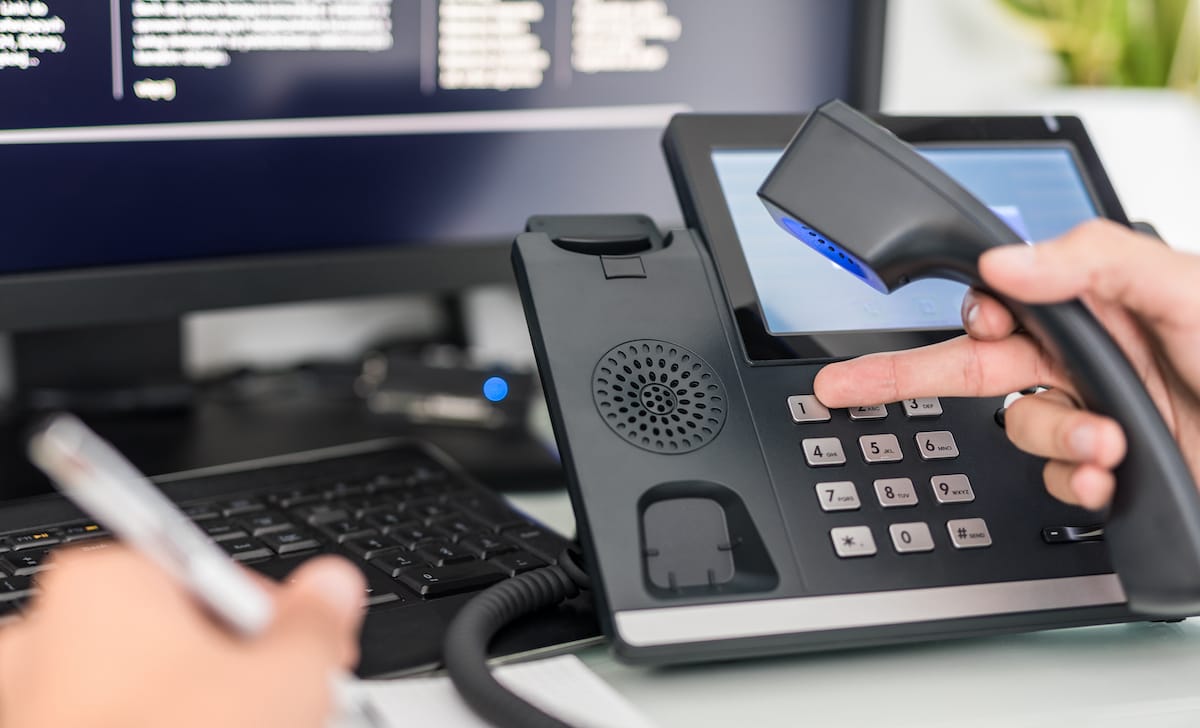
Man using a VoIP phone

“VoIP has transformed the way we can stay connected with out clients, anywhere at anytime.”

Packed with features

Calling is more fun with VoIP phone systems, because these phone systems are often accompanied by a variety of attractive features. Call waiting, call transferring, voice recognition, call forwarding, voicemail, caller ID, call blocking, automatic call distribution, etc. are just some of the many features that you may get to choose from, in your hosted VoIP service.

VoIP systems are feature-rich solutions that enable employees to operate as if they were in the office, even when they’re not. You can send voicemails to instant messaging or emails if the intended recipient isn’t available at the moment. It’s easy for organisations to centralise VoIP communication for better coordination. Other features include mobile integration, auto attendant, advanced call routing, conferencing, and call recording.

Integration with other softwares

Given the fact that VoIP is a technology based on the Internet, its integration with your normal business apps and software can be easily achieved.

You could combine VoIP with your email system, and be able to place calls through the email system itself or even with your CRM system, that way you can merge call records of a customer into the customer’s profile.

VoIP also works well with Microsoft Teams so that users can make and receive regular telephone calls either with their Teams app or with physical telephones.

You can schedule online meetings, chat to your co-workers and communicate easily between staff and customers. There are options to create a private or group chat whilst sharing files.

Increase productivity

The way VoIP works, the features it contains and the user friendliness of them allows for staff to become much more productive. Providing staff the ability to host virtual meetings, conduct international phone conferences at a small cost, attach important documents, share significant data through video conferencing and communicating with colleagues on a private chat software.

In recent years VoIP has really taken off quite significantly, especially in terms of voice clarity to the point that it can be clearer than your traditional phone line conversations. When VoIP first came to the market it was in need of some improvement: distorted calls, dropped calls and lagging transmissions to name a few. This is no longer the case and VoIP has now become one of the most popular ways of communication for businesses of all shapes and sizes.

Reliable and ready for ISDN switch off

In 2025, the UK’s ISDN network will be turned off. This means traditional telephone lines are being switched off, and more businesses will need to move to VoIP, so now is the time to set up your business with a digital phone line.

For a more in-depth overview about the 2025 switch off, what it means for your business, and whether to make the switch earlier with a possible cost saving, read our ISDN switch off page.

To find out more about how VoIP can transform your business, speak to one of our experts, contact us here.

How Much Better is 5G?

How much better is 5G?

You’ve probably heard the term 5G a lot more lately – it’s one of those phrases that has got the tech world buzzing, with many bold claims about the future being made by mobile networks, device manufacturers and tech journalists alike.

But what is 5G? And realistically, for the average small or medium business owner, what effect will it have?

To understand this, let’s remind ourselves of a little history. The 5 in 5G simply refers to this being the fifth generation of mobile networks. The first generation – remember playing Snake on those old Nokia phones? – let users make calls and not much else. The 1990s didn’t just bring us the Spice Girls and Britpop – they also gave us the second generation, complete with the ability to communicate by Short Message Service (SMS) – better known as texting.

At the turn of the 21st century, 3G enabled mobile data, bringing the internet, maps, and email to our phones for the first time. It was such an important technology that whole devices were named after it – Apple’s iPhone 3G among them. Finally – for now – 4G built on that use of data, giving us faster music streaming, video calls and more practical email and business applications on the go.

So what about 5G – that just means more speed, right? Well… yes and no. Speed is a factor but there is far more to it than that. The most exciting benefits are 5G’s portability, and its low latency – simply put, a shorter delay between a signal being sent and received.

The first of those benefits – portability – comes because 5G doesn’t need to be delivered through large mobile masts. It operates on much higher radio frequencies delivered by smaller access points, similar to WiFi networks. In urban areas we are likely to see these points on lampposts, billboards, and anywhere a network operator can cost-effectively install one. This means that current ‘blackspots’ and remote places – even those where even 4G isn’t available – could see much better connectivity on 5G.

The second benefit – low latency – will accelerate the growth of the Internet of Things (IoT) – this is where smart devices talk to each other over the network. In the consumer world, this has been referred to in terms of driverless cars and fridges that order milk when it runs out, but the business applications are more exciting than that.

Imagine, for example, turning up to a meeting with colleagues and partners from around the world through augmented reality, with some of the attendees there as holograms. Or a fleet of mobile plumbers in smart cars which can predict traffic patterns and take the most efficient routes from job to job. Or buildings fitted with smart sensors that can analyse the movement patterns of staff throughout the day – not only adjusting heating and lighting depending on where people are, but also using artificial intelligence to predict which rooms and facilities will be needed in an a hour, or two hours, or tomorrow. Cupboards that automatically order stationery, coffee machines that have a cuppa ready for every member of staff before the morning meeting, lights that automatically adapt to reduce eye strain at different times of the day, real time tracking of lone employees out at night and a host of applications nobody will have even thought of yet will be possible to make working life easier, more efficient and more enjoyable.

In the short term, businesses will certainly be able to enjoy faster, higher quality video conferencing, which, as anyone who has ever sat through a Skype business meeting or a Google Hangout knows, currently isn’t always an enjoyable or seamless experience. 5G could also encourage more remote working, with better quality connectivity, improving the ‘virtual workplace’ and supporting the movement towards more flexible working patterns – and much, much more.

Let’s not get ahead of ourselves though – however exciting they seem, truly connected buildings and Star Trek-style hologram meetings are still a long way off. Some companies which are renewing device contracts in the immediate future may want to consider becoming early adopters of the first 5G devices so they are ready for the changes that will come during the lifetime of those devices. Others may want to wait for more 5G-enabled technology to become available – for example, while Samsung has already unveiled its first 5G handsets, Apple has yet to reveal its plans.

It’s also unlikely we will see all regions in the UK benefiting from 5G for some years – so the impact on business will be slower in some areas than others. Aside from some localised tests, the rollout in the UK isn’t expected to begin until 2020, with full UK coverage coming much later. There will be no fanfare, no overnight switch-on – this is an evolution rather than a revolution. The best description we have heard is that adoption of 5G will be a “trickle followed by a rush”.

What’s important, though, is that businesses recognise the potential of this new technology and start to think about a road map for the next five years or so. At Onecom we will be starting and maintaining conversations with our customers about their individual needs and potential – and watch this space for more thoughts on how the 5G future will unfold.

ISDN to SIP – what does it mean?

ISDN to SIP – what does it mean?

Traditionally, Integrated service digital network (ISDN) technology allowed inbound and outbound voice calls through a ‘digital’ line – through the internet. But SIP trunking is now replacing ISDN services, which means ISDN will slowly be phased out over the next 5 years. Why? Because it’s better technology. Think 5G replacing 4G, which replaced 3G in turn. Gradually, they are then phased out as new technology comes along. Not only is it better technology, it’s also cheaper, more flexible and can help business future-proof their telecommunications systems.

What is ISDN?

ISDN stands for integrated service digital network. It originally appeared back in the 80’s but is still widely used in businesses. It became popular due to the fact that it allowed the opportunity to transmit both voice and data over the same line.

ISDN is a digital line that runs through copper wiring. It was a lot faster than traditional analogue lines and could be used for data as well as carrying voice calls. The main issue with ISDN is that it relies on physical infrastructure, the copper lines, which can be costly to maintain. It also requires an additional private telephone network that is used within the company (also known as a private branch exchange or PBX).

In a nutshell, ISDN takes up space, is costly to maintain and cannot easily be fixed when things break.

Replacing ISDN with SIP trunking

Session Internet Protocol (SIP) trunking is the next-in-line future-ready solution to replace ISDN. It’s still a digital connection, ensuring calls are transmitted via the internet. However, it connects the PBX to the network via broadband, Ethernet or a private circuit. It enables you to make calls via the internet. (NB: SIP is also known as VoIP, which struggled to take off due to early signal issues and problems. Therefore, SIP came along as technology advanced, enabling more reliable and scalable communication options for businesses.)

The trunking part? Well, that is a tech-jargon for a system which provides network access to many people by sharing a set of lines. Think of a tree trunk with many branches running off it or a network with a central hub. A ‘trunk’ is one communications channel between one point and another, typically one being the central hub.

SIP enables businesses to mange their communications more easily and have a more reliable solution that is flexible to their business needs.

Why does my business need SIP?

The main reason you should switch to SIP, is because ISDN is on its way out. BT completely plan to phase out ISDN by 2025, with Internet Protocol (IP) calling seen as a much-preferred alternative. We highly, recommend getting yourselves into the modern world and upgrading your phone lines. But don’t just take our word for it. Here’s more reasons why you should be looking at moving from ISDN to SIP.

You’ll save money

One of the major benefits of upgrading to SIP is that you can see unprecedented savings on your call costs. SIP means running your calls via the internet, which takes out the need for physical infrastructure and therefore, maintenance. It is suggested that business can save up to 50% on their business calls on average.

What’s more, as your line is run through the internet, providers often give you inclusive minutes included within your monthly charge. You can make even more savings, the larger your business too.

You get flexibility

With SIP adding new lines is really simple – in fact, it can be done in less than a minute. Calls via the internet can help you to meet business demand and control where your calls go easily.

Setting up new offices or working remotely is a lot easier as there’s no need for installing new lines. It also enables a business to keep their existing numbers, even when they move locations.

SIP trunking is scalable, which means it can be grown with your business really easily.

You get more reliability

When traditional ISDN connections go down, it can be timely and difficult to fix. Your business can be out of action for hours, if not days. Business continuity is reliant upon maintain connections.

With SIP trunking you get a new level of resilience. Your calls can be diverted to a different line or redirected to another office. It also enables calls to be redirected to mobiles too, which can be great for remote workers or employees out for meetings.

Stepping towards SIP

Switching lines can be met with resistance. Particularly, because traditionally switching can cause disruptions within a business.

However, your switch to SIP can be flexible. You can switch in one move or phase the transition by each site, office or even floor. One of the best benefits is that SIP can actually work alongside ISDN so there’s no need to worry about down time.

In fact, there’s little disturbance to your business activities, if any. Testing and checks can be carried out in a controlled environment too.

With the removal of ISDN there is no good reason to continue using old phone lines. Especially, when you can save money, get more reliability and have calls that can meet your business demand.

For more information about making the transition from ISDN to SIP trunking, contact our team at ATS Connection today on 01903 357002  today or get in touch.  

ISDN Switch Off: The Deadline Is Now January 2027

This page has been updated. The ISDN switch off did not complete in December 2025. Openreach extended the deadline, and the analogue network now shuts down permanently on 31 January 2027.

For the current position, including the 2026 price rises on legacy lines and what happens to alarms, lifts and card machines, read our full guide: The Big Switch Off: what the January 2027 landline shutdown means for your business.

What is ISDN?

ISDN stands for Integrated Services Digital Network. It is a digital line that runs over copper wiring, and it was considerably faster than the traditional analogue lines that came before it, carrying both data and voice calls. Its weakness is that it depends entirely on physical copper infrastructure, which is expensive to maintain and increasingly difficult to repair.

Why the date moved

Openreach announced back in 2015 that it would stop selling ISDN in 2020 and switch the network off in 2025. The stop sell happened as planned in September 2023, and no new ISDN or analogue lines have been available since.

The final shutdown, however, was pushed back. In 2024 the deadline moved from December 2025 to 31 January 2027, largely to allow more time to migrate vulnerable users and telecare devices safely. That extension is the reason this page needed rewriting.

The new date is fixed. Openreach has been clear it will not move again, and exchanges are already being migrated in phases, so many businesses will lose analogue service before January 2027 rather than on the day itself.

What to do if you still have an ISDN line

You need to migrate to a digital service, which in practice means VoIP. Your existing numbers can be ported across, so nothing changes for your customers.

Two things are worth knowing. First, VoIP depends on your internet connection, so if your broadband is also running over the old copper network it makes sense to upgrade both together. Second, it is not only phones that are affected. Alarm panels, lift emergency lines, door entry systems and older card terminals all commonly sit on analogue lines and need their own migration path.

Legacy line rental is also rising steeply through 2026 in three separate wholesale increases, so staying on copper is now the expensive option as well as the one with a deadline attached.

Get help before the deadline

We migrate businesses across West Sussex from ageing ISDN and analogue setups onto modern hosted phone systems, handling the audit, the number porting and the connectivity as one project.

Call 01903 255 159 or read the full Big Switch Off guide to see what applies to you.

One in five homes can get full fibre broadband

More than one in five UK homes can now access faster, full-fibre broadband, according to new figures published by Ofcom.

Ofcom’s latest Connected Nations data highlights broadband and mobile coverage across the UK and its nations.

As of January this year, around six million UK homes (21%) could get full-fibre broadband – up from 18% in September last year. Broadband delivered over full-fibre networks is faster and more reliable than the decades-old copper connections that most people still use.

There has also been a significant increase in the availability of gigabit-capable connections. This includes broadband delivered over full fibre networks and the fastest cable technology. 11 million homes (37%) can now get gigabit-capable services – up from around 8 million (27%) last September.

Availability of superfast broadband remains at 96% and mobile coverage has remained stable. Mobile coverage is set to increase across the UK as companies continue to roll out a Shared Rural Network.

Source: www.ofcom.org.uk